

At American Tortoise Rescue, we’ve seen it all. Over the decades, we’ve rescued thousands of animals that were the victims of simple misinformation. People often get a turtle because they think they are “low-maintenance” or “starter pets.” False. To save lives, we have to bust these myths wide open. If you are thinking about bringing a turtle into your life, or if you already have one, read this carefully.
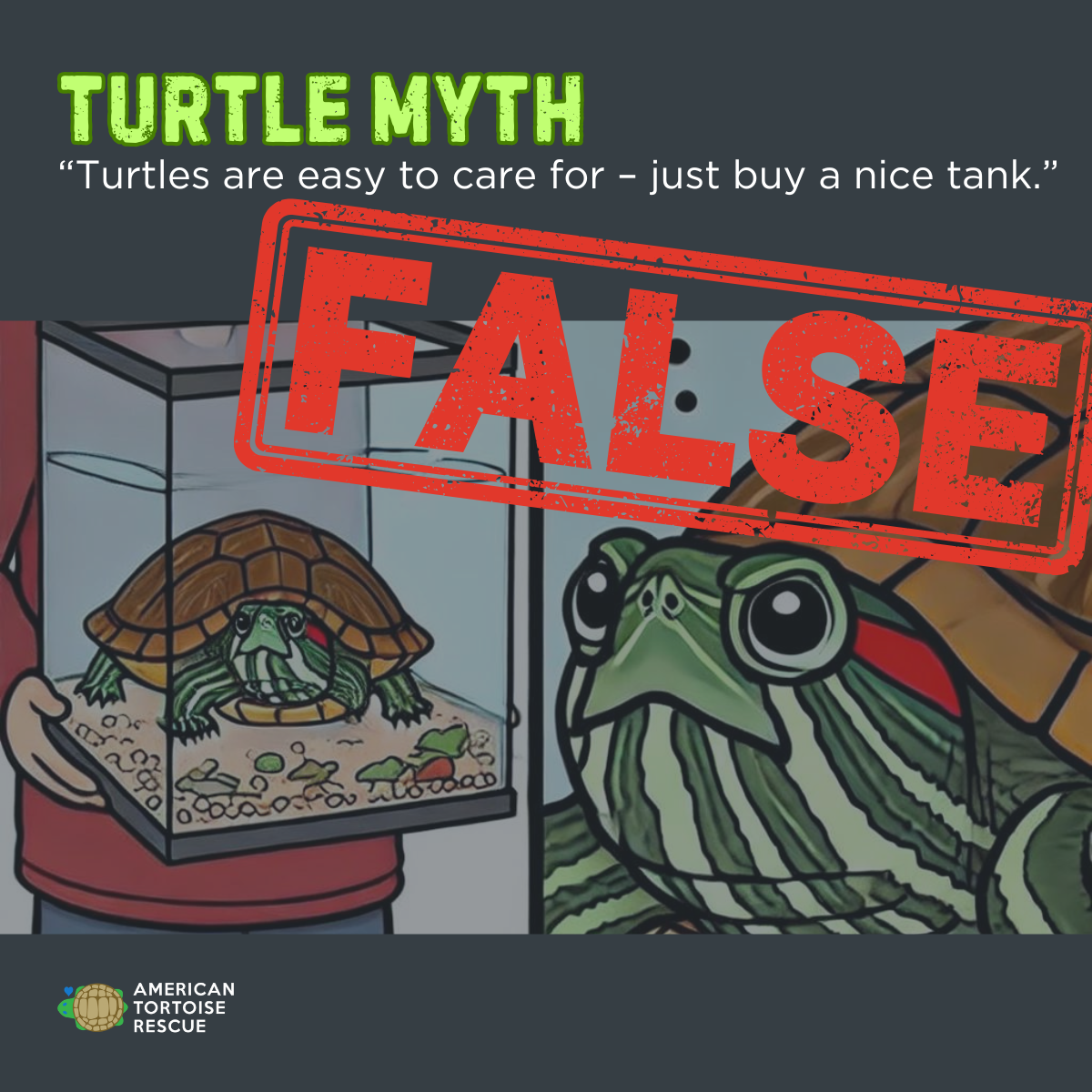
Myth 1: Turtles are easy to care for—just buy a nice tank.
FALSE. Turtles are wild animals, not home decor. In nature, these creatures have home territories that can be many miles wide. Putting a turtle in a glass tank is cruel and unnatural. Think of it this way: it’s like spending the rest of your life living in your bathtub. You might survive, but you certainly wouldn’t be thriving. A turtle needs a large, secure outdoor habitat or a properly filtered pond to approximate nature. If you can’t provide a massive space, you shouldn’t have a turtle.
Myth 2: Turtles usually live about five years.
FALSE. This myth exists because so many turtles die from poor care within their first few years. In reality, a well-cared-for turtle is a lifelong commitment. They can easily live 25, 50, or even 100 years. These animals have been on Earth for 200 million years—longer than the dinosaurs. When you adopt a turtle, you aren’t just getting a pet; you are getting a family member that will likely have to be in your will, and maybe even your children’s will.
Myth 3: Turtles do not need veterinary care like dogs and cats.
FALSE! This is one of the most dangerous misconceptions. Because turtles have an incredibly slow metabolism, they are masters at hiding illness. They won’t whine or limp like a dog; they simply suffer in silence until the illness is very advanced. You must be hyper-aware of these red flags: closed or swollen eyes, loss of appetite, sitting in one place looking miserable, changes in their daily patterns, or a runny nose. If you see any of these, see an exotic vet immediately. Most regular dog and cat vets do not have the specialized training to treat chelonians.
Myth 4: It is best to buy turtles and tortoises at a pet store.
ABSOLUTELY FALSE. Pet stores should sell pet supplies, not living lives. Many pet stores buy their stock from cruel trappers who snatch them from the wild. The statistics are heartbreaking: about 90 percent of these animals die in transit before they even reach the store shelf. Don’t support this industry. Get your turtle the same way you’d get a dog or cat—go to your nearest animal shelter or find a reputable reptile or turtle rescue online. Adopt, don’t shop.
Myth 5: Turtles hide under plants to hibernate.
PARTIALLY TRUE, BUT SPECIES-DEPENDENT. Every species has its own unique biological “instruction manual.” Some, like Box Turtles, will burrow into the soil and hide under leaf litter. Others, like Red Eared Sliders and Cooters, hibernate underwater at the bottom of ponds. Whichever way they do it, the most important rule is this: your turtle must be healthy and “heavy” (well-hydrated and fed) before it is allowed to go to sleep for the winter. A sick or underweight turtle may never wake up.
Myth 6: Turtles hiss like snakes when they are mad.
FALSE. While the sound a turtle makes certainly sounds like a hiss, the intent is totally different. When a turtle is frightened or picked up suddenly, it pulls its head into its shell with incredible speed. This rapid movement forces the air out of its lungs, creating that “hissing” sound. It is a biological reflex of the respiratory system, not a deliberate “angry” warning like a snake would give.
Myth 7: Turtles can eat just about anything.
FALSE. Turtles are primarily carnivores. In the wild, they hunt and eat live food like snails, fish, and worms. You can supplement this with high-quality prepared turtle food, but they should never be fed human “junk” like hot dogs, raw hamburger, or cat food. These are not items they would ever find in nature and can cause massive internal damage. Also, remember: Water turtles can only eat under water. If you put food on dry land for a water turtle, they can’t swallow it.
Myth 8: Tiny water turtles stay that size.
FALSE! We see these all the time: small green water turtles sold in plastic “death bowls” with a tiny fake palm tree. Those are hatchlings. If they survive, they will grow to be anywhere from 6 to 12 inches long. Furthermore, it is a federal crime in the U.S. to buy or sell turtles under four inches. The law is there for a reason—to protect the animals and your health.
Myth 9: Washing a turtle gets rid of Salmonella.
FALSE. You cannot “scrub” the Salmonella off a turtle. Assume that every single turtle, no matter how clean it looks or how many baths it gets, is carrying Salmonella. To stay safe, you must wash your hands every single time you handle the turtle or touch its water. Keep turtle equipment far away from the kitchen and never keep turtles in homes where children under the age of six live, as their immune systems are more vulnerable.
Myth 10: Turtles can live happily with artificial light.
FALSE. A $20 bulb from a pet store is no replacement for the sun. Turtles need real, unfiltered sunlight to grow normally and maintain strong bones. Sunlight allows them to synthesize Vitamin D3, which is required for calcium metabolization. Turtles deprived of the sun often develop Metabolic Bone Disease (MBD), a horrific condition where their bones literally disintegrate. A basking turtle in the actual sun is a happy, healthy turtle.
🐢 A Quick Note from our team:
While many of the stories, photos, and life-saving care tips found in our Resource Hub were born during our 35 years at our Malibu, California sanctuary, please note that as of late 2025, American Tortoise Rescue no longer operates a physical sanctuary location.
Don’t worry—the mission hasn’t skipped a beat! Our beloved resident “shellebrities” are enjoying their golden years at Turtle and Tortoise Rescue of Arroyo Grande up the coast, and our work has shifted entirely to global advocacy, education, and shellebration. While we no longer take in new surrenders at a physical site, we are more dedicated than ever to helping you “shellebrate” and protect turtles in your own backyard!

A global movement by American Tortoise Rescue® dedicated to protecting turtles and tortoises and their habitats around the world.
Explore
Organization